
Blinded at the Edge: Solving the Warzone UAS Compute Deficit with Dell Federal and Paragon Micro
Underpowered drones stall in contested airspace when jammed links block cloud processing. Pairing Dell Federal rugged edge servers with Paragon Micro Public Sector’s secure staging, STIG hardening, and supply-chain assurance brings real-time AI inference to the tactical edge—turning raw UAS data into instant action.
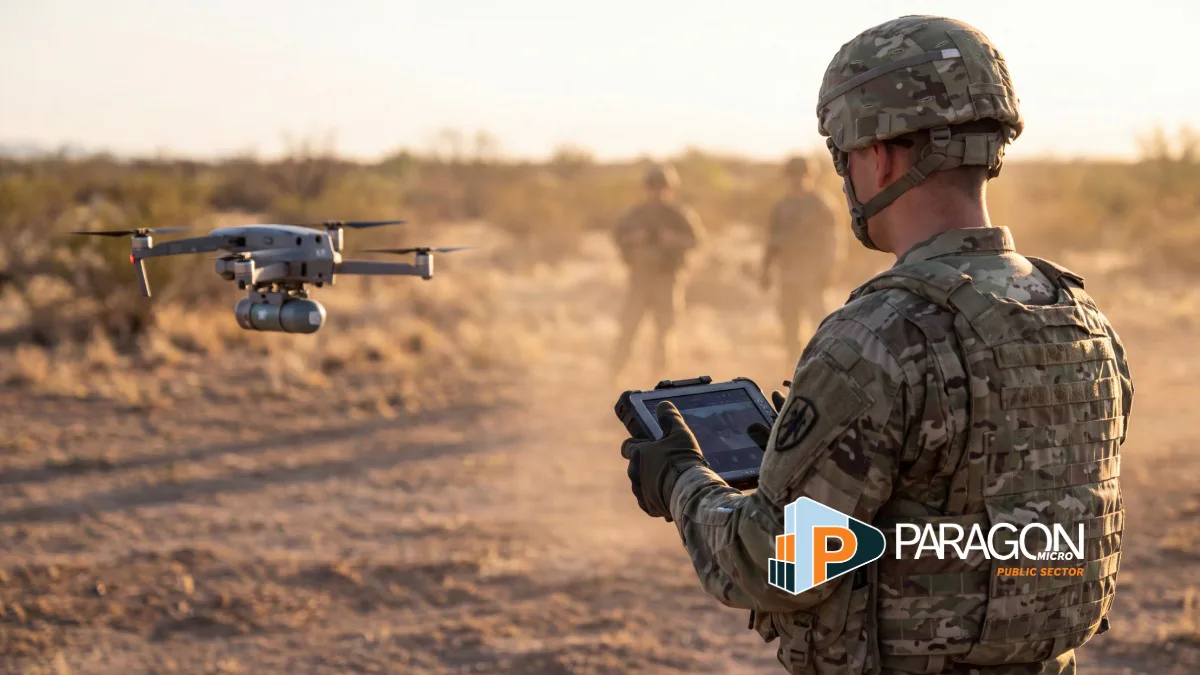
**Blinded at the Edge: Solving the Warzone UAS Compute Deficit with Dell Federal and Paragon Micro ** Unmanned Aerial Systems (UAS) dominate modern battlefields, yet most deployed platforms suffer from a fatal architectural flaw: their sensors collect far more intelligence than their onboard processors can analyze. When drones fly into contested airspace without adequate tactical compute, raw video piles up, targeting loops stall, and expensive unmanned fleets become flying cameras waiting on broken communication links.
Pairing Dell Federal ruggedized edge infrastructure with turnkey staging, supply-chain assurance, and tactical integration from Paragon Micro Public Sector moves high-density AI inference directly into the fight—turning raw unmanned telemetry into immediate decision dominance.
Why Underpowered UAS Platforms Fail in Contested Airspace
Modern tactical drones operate under unforgiving Size, Weight, Power, and Cost (SWaP-C) ceilings. Every watt allocated to an onboard GPU drains battery endurance, adds thermal signature, and increases the unit cost of an airframe that may not survive the sortie. As a result, most Group 1 through Group 3 UAS platforms carry just enough embedded processing to handle flight stabilization, basic waypoint navigation, and raw sensor capture.
In permissive airspace, operators mask this onboard compute deficit by streaming raw full-motion video (FMV) back to rear-echelon data centers or cloud environments. In a peer or near-peer warzone, that architecture collapses across four failure points:
The DDIL Chokehold: In Denied, Degraded, Intermittent, and Limited (DDIL) environments, adversaries actively jam satellite communications, spoof GPS, and hunt radio-frequency (RF) emitters. Drone teams operating under emissions control (EMCON) cannot push high-bandwidth video streams back to sanctuary clouds without exposing their ground control stations to counter-battery fire.
The ISR Data Deluge: Modern multi-spectral payloads—combining electro-optical/infrared (EO/IR), synthetic aperture radar (SAR), and electronic warfare (EW) sniffers—generate up to 22 terabytes of data per day across tactical formations. Narrowband tactical radios cannot move terabytes of raw imagery, creating an immediate intelligence backlog.
Lethal OODA Loop Latency: Waiting minutes for distant analysts or cloud endpoints to classify a camouflaged mobile launcher or re-task a drone swarm cedes the initiative. By the time a target is confirmed off-site, it has relocated.
Static Threat Models: Adversaries adapt electronic warfare signatures, decoys, and camouflage daily. Without forward compute capable of local model fine-tuning and rapid weight updates, UAS computer-vision algorithms go blind against novel battlefield tactics within days.
Shifting the Compute Center of Gravity with Dell Federal Edge Infrastructure
Airframes in a modern warzone are increasingly consumable; the forward-edge infrastructure that orchestrates them is not. Rather than strapping fragile, power-hungry server hardware onto expendable drones, defense architects solve the UAS compute gap by anchoring a high-density, ruggedized compute tier right beside the tactical operator—inside mobile command vehicles, forward tactical shelters, and transit-cased ground control hubs.
Dell Technologies—a core OEM partner of Paragon Micro—engineered the PowerEdge XR rugged server portfolio specifically to bring enterprise AI and sensor-fusion muscle into austere combat zones:
Built for Shock, Dust, and Thermal Extremes: Platforms like the Dell PowerEdge XR8000, XR7620, XR5610, and ultra-compact XR4000 are tested to MIL-STD-810H and NEBS Level 3 standards, operating continuously in temperatures from -5°C to 55°C (23°F to 131°F) through heavy shock, high vibration, and particulate exposure.
Short-Depth, Transit-Case Density: At roughly half the depth of standard data center racks (down to 430 mm / ~14 inches), the PowerEdge XR chassis mounts cleanly into Humvees, tactical trailers, maritime vessels, and two-person portable transit cases, with front-accessible I/O and hot-swappable modular sleds for rapid field servicing.
Real-Time AI & Multi-Sensor Fusion: Equipped with high-core-count x86 processors and tactical GPU acceleration (including NVIDIA H100/H200 and compact PCIe accelerators), a single ruggedized cluster ingests simultaneous MANET mesh feeds from an entire UAS swarm. Vision-language models and target-recognition algorithms run locally on the chassis—filtering out empty terrain and transmitting kilobyte-sized target coordinates instead of raw gigabyte video streams.
Zero-Cloud Autonomous Continuity: Out-of-band management via Dell iDRAC, locking security bezels, self-encrypting drives, and silicon-level root of trust keep sensitive data and CUI protected even when forward teams operate completely disconnected from external networks.
From Commercial Boxes to Combat-Ready Systems: The Paragon Micro Advantage
Procuring rugged servers is only half the battle. Dropping unconfigured commercial off-the-shelf (COTS) hardware pallets onto a forward operating base forces uniformed communicators to spend weeks wrestling with firmware mismatches, cabling, encryption, power budgets, and multi-vendor licensing.
Paragon Micro Public Sector eliminates field-integration friction by delivering turnkey, validated tactical edge ecosystems backed by verifiable operational credentials.
Proof Before Production at Scale: Inside its 55,000+ sq. ft. System Readiness Center, Paragon Micro receives, racks, cables, burn-in tests, STIG-hardens, and asset-tags multi-OEM tactical kits before a single transit case ships to the mission site. The facility stages up to 1,000 devices daily while maintaining a documented less-than-1% dead-on-arrival and defect rate across programs.
Controlled U.S. Citizen Custody: Every federal hardware build is executed exclusively by 100% vetted U.S. citizens under camera-monitored, serialized custody from intake through final release.
Audited Counterfeit & Taint Defense: Adversaries actively target defense supply chains long before hardware reaches the battlefield. Paragon Micro backs its integration pipeline with four third-party audited certifications: AS5553 (counterfeit electronic parts avoidance), AS9120 (aerospace/defense serial-number traceability), ISO/IEC 20243:2018 (O-TTPS protection against malicious hardware taint), and ISO 9001:2015 (quality management).
Multi-OEM Integration Without Finger-Pointing: UAS ground stations require more than a server sled—they demand ruggedized routing, MANET radio interfaces, tactical UPS power, encryption, and storage working as one unit. Backed by 300+ technical certifications, Paragon Micro's named solution architects unify Dell Federal compute with tactical networking and field power under one accountable engineering lead, proven in OCONUS tactical deployments such as the U.S. Air Force 2nd Air Support Operations Squadron (ASOS) in Germany.
Capture-Speed Quoting & Ready Contract Vehicles: In-house federal engineering and PMO teams turn Rough Order of Magnitude (ROM) requests into firm partner quotes in 48 to 72 hours. Mission owners and defense primes—where Paragon Micro already holds $36M in proven sub-awards across 15 primes, plus $369M+ in trailing 36-month prime obligations—can rapidly procure complete Dell Federal tactical edge solutions through NASA SEWP VI, Army ITES-4H, MDA SHIELD, and GSA MAS.
Unmanned superiority in tomorrow's conflicts will not be won by whoever launches the most airframes, but by whoever processes the battlespace fastest when the network goes dark. Combining Dell Federal's rugged PowerEdge XR compute with Paragon Micro Public Sector's secure integration center ensures warfighters never bring a cloud-dependent drone to an electronic-warfare fight.
What this article covers
Each tag opens the page on TeamingIndex. “More articles” lists other articles with the same tag.
- Companies
About the author
Daniel HIlarski · A company on TeamingIndex
Report this article
Something wrong, confidential or out of place? Tell us and the TeamingIndex help desk will look at it.
You need to be signed in to report an article, so we can follow up with you.
Sign in to reportComments are not available on articles. To talk with the author, open their profile on TeamingIndex.
Articles are written by TeamingIndex members and reflect their own views. TeamingIndex does not check every claim. Verify contract, registration and compliance facts with the official source before you rely on them.